Real Estate PR vs. Marketing: What’s the Difference?
If you’ve ever Googled “how to get more real estate clients,” you’ve probably come across two terms thrown around almost interchangeably: public relations (PR) and marketing. Many real estate professionals assume they mean the same thing — or worse, they invest heavily in one while completely ignoring the other.
Here’s the truth: PR and marketing are not the same. They serve different purposes, operate through different channels, and produce different results. Understanding the distinction could be the difference between a real estate brand that merely runs ads and one that people genuinely trust and talk about.
In this post, we’ll break down exactly what separates real estate PR from marketing, where they overlap, and how smart professionals use both together to dominate their markets.
The Simple Version First
Before diving deep, here’s a one-line distinction to anchor everything that follows:
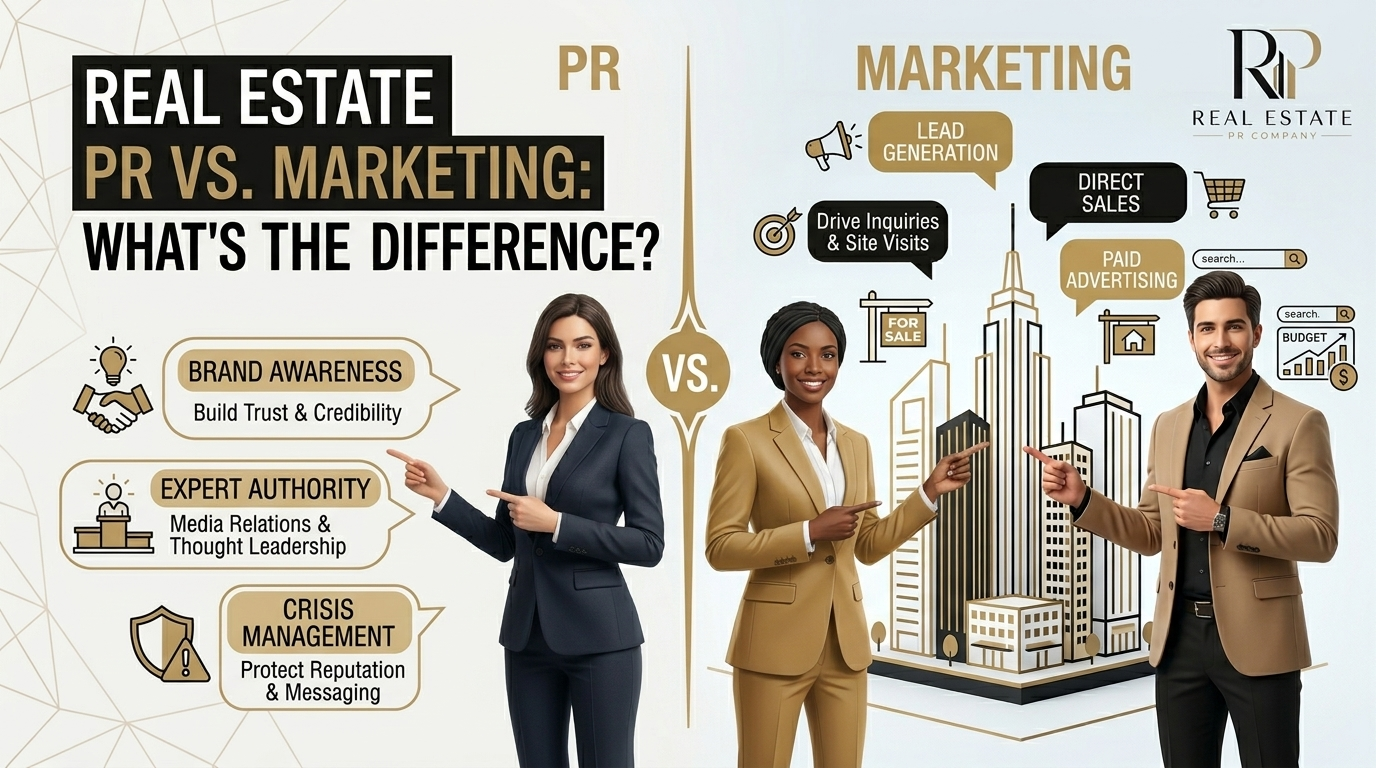
Marketing is what you say about yourself. PR is what others say about you.
Marketing is a controlled effort — you craft the message, you pay (or produce) to deliver it, and you choose the audience. PR, on the other hand, is about earning credibility through third parties: journalists, media outlets, influencers, community organizations, and word-of-mouth.
Both are essential. But they work very differently in real estate.
What Is Real Estate Marketing?
Real estate marketing refers to any paid or owned activity that promotes your services, listings, or brand directly to potential clients. You control the message entirely.
Common Real Estate Marketing Activities
- Paid advertising — Google Ads, Facebook and Instagram ads, Zillow Premier Agent placements
- Email campaigns — Drip sequences for buyers, sellers, and past clients
- Social media content — Posts, reels, and stories you publish on your own channels
- Listing presentations — Branded materials used in client meetings
- Direct mail — Postcards, “just sold” flyers, neighborhood newsletters
- SEO and content marketing — Blog posts, neighborhood guides, and video content optimized for search
- Open house promotions — Signage, digital ads, and event listings
The defining characteristic of marketing is control. You decide what gets said, when it goes out, and exactly who sees it. You’re paying for that control — either with money (paid ads) or time (organic content).
What Marketing Does Well
Marketing excels at generating leads and keeping your brand visible. It’s measurable: you can track how many people clicked your ad, opened your email, or visited your website. It’s also scalable — spend more, reach more.
For real estate professionals, marketing is the engine that keeps the pipeline full. Without it, the phone stops ringing.
The Limitation of Marketing Alone
Here’s where it gets interesting. Marketing has one significant weakness: people know you’re paying to talk about yourself.
A buyer sees your Instagram ad and thinks, “Of course they say they’re the best agent in the area — they wrote that themselves.” That skepticism is natural. In an industry built on trust, self-promotion only goes so far.
This is where PR comes in.
What Is Real Estate PR?
Public relations in real estate is the strategic effort to shape how the public, media, and community perceive your brand — through channels you don’t own or pay for directly.
When a local journalist quotes you as a real estate expert in a market trends article, that’s PR. When a regional business magazine features your brokerage in a “fastest growing companies” list, that’s PR. When a podcast invites you on to discuss the housing market, that’s PR. When the community talks positively about your sponsorship of a neighborhood event, that’s PR.
Common Real Estate PR Activities
- Media relations — Building relationships with journalists and securing press coverage
- Press releases — Announcing milestones, new hires, record sales, or community initiatives
- Thought leadership — Contributing guest articles to real estate publications or local business outlets
- Speaking engagements — Presenting at industry conferences, community town halls, or local business events
- Award submissions — Applying for and winning industry recognition
- Crisis communications — Managing reputation during disputes, negative reviews, or market controversies
- Community involvement — Sponsorships, partnerships, and local initiatives that generate goodwill
- Influencer and blogger outreach — Getting coverage from real estate content creators or local lifestyle bloggers
What PR Does Well
PR builds something marketing alone can’t easily manufacture: credibility through third-party validation.
When a respected publication says you’re the go-to agent for luxury condominiums in your city, that carries far more weight than any ad you could run. The reader trusts the publication. And by extension, they extend that trust to you.
PR also has incredible staying power. A well-placed article can be discovered on Google for years. A speaking slot at a respected conference positions you as an authority for a long time after the event. Marketing campaigns, on the other hand, stop working the moment you stop paying for them.
The Limitation of PR Alone
PR is not a lead generation machine. You cannot predict exactly when a journalist will cover your story, when your press release will land, or how quickly a speaking opportunity will translate into new business. Results can take months to build.
PR also requires patience, relationships, and consistency. It’s not a switch you flip. For real estate professionals who need clients right now, PR alone won’t fill that gap quickly.
Key Differences at a Glance
| Factor | Real Estate Marketing | Real Estate PR |
| Who controls the message | You do | Third parties (media, public) |
| Cost structure | Paid (ads, tools, production) | Earned (relationships, pitching) |
| Speed of results | Fast (campaigns launch quickly) | Slow (takes time to build) |
| Credibility level | Moderate (self-promotion) | High (third-party endorsement) |
| Measurability | High (clicks, conversions, ROI) | Lower (harder to track directly) |
| Longevity | Short (stops when you stop paying) | Long (articles live on search engines) |
| Primary goal | Generate leads, drive transactions | Build trust, manage reputation |
| Best for | Short-term pipeline filling | Long-term brand authority |
Where Real Estate PR and Marketing Overlap
While they’re distinct disciplines, PR and marketing often work together — and the best real estate brands use them in tandem.
Content Is the Bridge
A blog post you write for your website is marketing. But if that same blog post gets picked up by a regional real estate publication? That’s PR. The content serves both functions.
Similarly, a press release is a PR tool — but distributing it through email to your client list is marketing. A podcast interview is a PR win — but promoting that episode on your social media channels is marketing.
Reputation Feeds Results
Strong PR coverage builds the kind of credibility that makes your marketing perform better. When someone sees your ad after already reading about you in a news article, they’re far more likely to click, call, or convert. PR warms the audience; marketing converts them.
Digital PR Blurs the Line Further
In the digital age, the line between PR and marketing has become even thinner. SEO-driven content marketing can function as digital PR when it earns backlinks from authoritative websites. Social media can be both a marketing channel (paid ads) and a PR tool (organic reputation building). Influencer partnerships blend paid marketing with earned endorsement.
This overlap is actually a good thing — it means your PR efforts can amplify your marketing, and your marketing content can fuel new PR opportunities.
Real-World Examples in Real Estate
Example 1: The Solo Agent
Marketing approach: Runs Facebook ads targeting first-time homebuyers in her city. Posts market updates on Instagram three times a week. Sends a monthly email newsletter to past clients and leads.
PR approach: Pitches a local news outlet with a story angle about rising inventory in the city’s starter home market. Gets quoted in an article. Shares that article across all her channels. The article ranks on Google for “starter homes [city name].” New buyers find it and contact her directly.
The combined effect: Her ads generate immediate leads. Her media coverage builds long-term credibility and organic discovery. Prospects who find her through the article are already pre-sold on her expertise before picking up the phone.
Example 2: The Property Developer
Marketing approach: Launches a digital campaign for a new mixed-use development. Runs targeted ads on Instagram and LinkedIn for investors and lifestyle buyers. Creates a dedicated landing page with renderings and pricing.
PR approach: Issues a press release about the development’s sustainable design and community impact. Secures coverage in a regional architecture and lifestyle publication. The CEO is invited to speak at a local urban planning conference.
The combined effect: Marketing drives early registrations and sales inquiries. PR establishes the development as a community asset, not just another project — reducing resistance from neighbors and building anticipation among lifestyle buyers who trust editorial coverage more than ads.
Example 3: The Real Estate Brokerage
Marketing approach: Invests in local SEO, Google Ads, and a referral marketing program for past clients.
PR approach: Submits for industry awards, positions the founder as a thought leader with guest articles in business publications, and sponsors a local housing affordability initiative that earns news coverage.
The combined effect: Marketing ensures the brokerage appears when people are actively searching. PR ensures people already know and respect the brand before they start searching.
Which One Should You Focus On?
The honest answer: it depends on where you are in your business.
If you’re just starting out and need clients immediately, lean into marketing first. Build your visibility, generate leads, and start creating the foundation of your brand presence. PR is hard to earn if no one knows who you are yet.
If you’ve been in the business for a few years and have a solid client base, this is the right time to layer in PR. Use your existing expertise, track record, and results to earn media coverage and build the kind of reputation that attracts premium clients and referrals without relying entirely on ad spend.
If you’re growing a team or brokerage, both PR and marketing should be running simultaneously — ideally with dedicated people or agencies responsible for each.
If you’re a developer or launching a large project, PR becomes critical before and during the launch. Managing community perception, local government relationships, and investor confidence is a PR function that marketing simply cannot fulfill.
Do You Need a Real Estate PR Company?
A specialized real estate PR company brings something generic marketing agencies can’t: deep knowledge of the industry’s media landscape, key journalists, and what story angles actually work in real estate.
They know which publications cover housing market trends. They understand how to position an agent as a thought leader rather than just a salesperson. They have existing relationships with editors who cover real estate, architecture, and urban development.
For professionals who are serious about building a long-term brand — not just running ad campaigns — working with a real estate PR company is a logical investment. Think of it this way: marketing can make you visible. PR makes you believable.
Final Thoughts
Real estate is a trust-based industry. People don’t hire the agent with the most ads — they hire the one they believe in. They invest in the development that feels credible, community-focused, and worthy of their money.
Marketing gets you in front of people. PR gets people to trust you.
You don’t have to choose between them. In fact, the most successful real estate professionals and companies understand that PR and marketing are complementary forces — each making the other more powerful.
So the next time someone asks you whether to invest in PR or marketing for your real estate business, the right answer isn’t either/or. It’s both — in the right order, at the right time, with a clear understanding of what each one is actually supposed to do.